



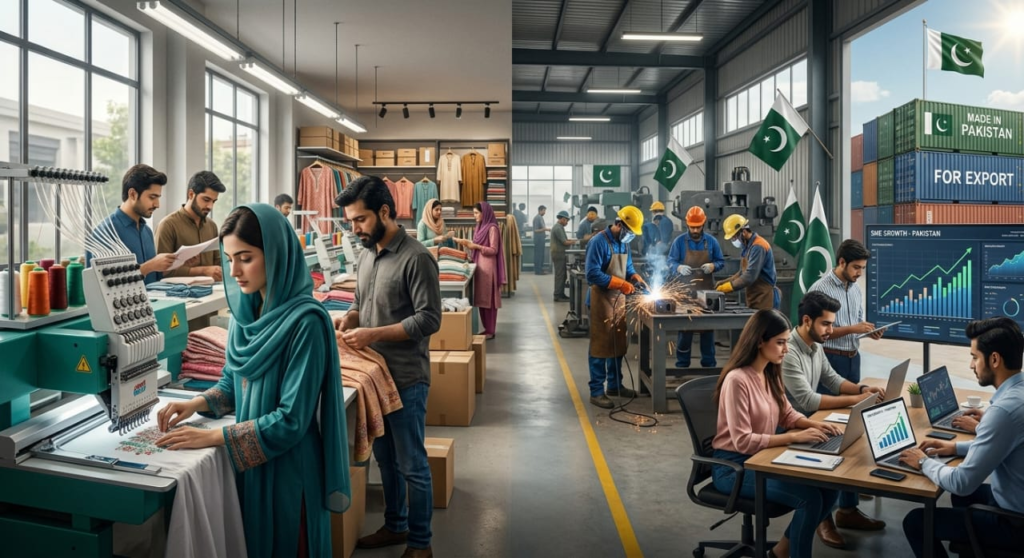
ISLAMABAD (Special Report) — July 26, 2026 — In a strong declaration aimed at revitalizing domestic industry and empowering small entrepreneurs, the Government of Pakistan has officially reaffirmed its commitment to Micro, Small, and Medium Enterprises (MSMEs), declaring them the true backbone of the national economy. With millions of households relying on small enterprises for income and employment, state policymakers are shifting focus toward structural support to unlock the sector’s full economic potential.
Executive Summary & Key Takeaways
- Economic Backbone: Government officially designates Micro, Small, and Medium Enterprises (MSMEs) as the core engine of national employment and economic resilience.
- 4-Pillar Support Framework: Comprehensive roadmap focuses on accessible financing, tech integration, skill development, and expanded market access.
- Growth Vision: Direct intervention aims to elevate industrial productivity, expand export horizons, and drive sustainable economic development.
Empowering Millions: The Socio-Economic Imperative
Small and medium-sized enterprises constitute the vast majority of commercial activity across urban and rural centers in Pakistan. Senior government officials highlighted that empowering this sector goes beyond business growth—it is a critical driver of poverty alleviation, job creation, and socio-economic empowerment.
By addressing systemic barriers that have historically held back small business owners, the government aims to transition informal micro-enterprises into structured, high-yield commercial players capable of competing in international markets.
The Strategic 4-Pillar Support Package
To translate commitment into measurable progress, the government’s new policy roadmap introduces targeted interventions structured around four primary growth drivers:
| Core Pillar | Strategic Focus & Operational Impact |
|---|---|
| 1. Simplified Financing | Expanding credit facilities, easing collateral burdens, and creating dedicated micro-loan schemes. |
| 2. Tech Adoption | Facilitating digital transformation, e-commerce integration, and modern machinery upgrades. |
| 3. Capacity Building | Rolling out specialized vocational training, financial literacy, and managerial skill programs. |
| 4. Market Access | Connecting domestic MSMEs with global trade corridors and streamlined export channels. |
Boosting Export Capacity and Long-Term Stability
Economic analysts emphasize that enhancing SME productivity is key to narrowing Pakistan’s trade deficit. By enabling local manufacturers to meet international quality standards and enter global supply chains, the government’s policy framework seeks to create a diversified, export-led economic model.
The Road Ahead
The government’s renewed focus on MSMEs comes at a crucial juncture for Pakistan’s economic reform agenda. Industry experts agree that with swift execution, transparent credit distribution, and sustained public-private collaboration, the initiative can usher in a new era of industrial productivity and economic self-reliance.